Feb. 6, 2026
Programs celebrate Court Reporting Week
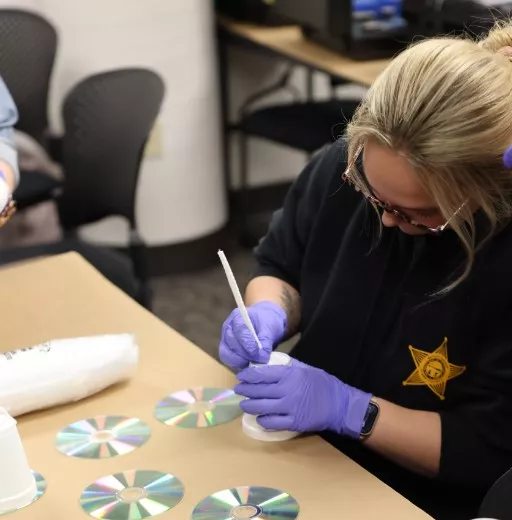
Governor Mike DeWine and Lieutenant Governor Jim Tressel have declared Feb. 7–14 Ohio Court Reporting and Captioning Week, honoring the vital work of court reporters and noting the connection between court reporting and the criminal justice system, with programs like those at Clark State College preparing students for careers in both fields.
Clark State’s fully online judicial court reporting program trains students to produce transcripts of court proceedings, depositions, hearings and arbitrations. Using computerized stenography machines and computer-aided transcription software, students learn to provide realtime translation for all parties, whether in the courtroom or participating remotely. The program includes job shadowing experiences and a required internship to provide students hands-on experience in real-world judicial settings.
Court reporting and criminal justice are closely connected, as court reporters serve as essential “guardians of the record” within the judicial system, producing verbatim transcripts of criminal trials, hearings and depositions. They work alongside judges, law enforcement and other legal professionals to ensure accurate, legally recognized documentation, making their role a critical part of the criminal justice process.
“Court reporting is a fast-paced, rewarding profession with opportunities in courtrooms, depositions, hearings and even realtime captioning for remote participants,” said Robyn Hennigan, senior technical instructor and program coordinator of Clark State’s judicial court reporting program. “Our students graduate ready to step into these roles and make an immediate impact in the legal system.”
Graduates of Clark State’s court reporting program are prepared for careers in courts, court reporting firms, arbitration firms, government agencies and captioning firms. According to the U.S. Bureau of Labor Statistics, court reporters and simultaneous captioners earned a median annual wage of about $67,000 in 2024, with pay varying based on experience, certifications and location.
Clark State also offers an associate degree in criminal justice, with pathways in law enforcement and corrections. The corrections pathway focuses on probation, parole and adult and juvenile corrections, while the law enforcement pathway emphasizes criminal law, patrol operations, forensic science, investigations and community relations. Students gain practical, hands-on skills through experienced faculty and may defer courses if they have completed an Ohio Peace Officer Training Academy-approved basic training.
“By pursuing an associate degree in criminal justice, students aren't just preparing for a job—they are preparing to make a tangible, positive impact on their communities,” said Wendy Holt, criminal justice program coordinator and assistant professor. “Whether serving as a victim advocate, a probation officer or a court specialist, our graduates step into vital roles that ensure justice and safety for everyone.”
Enrollment for the fall semester begins March 17. Fall semester begins August 17. Learn more about both programs and enroll at clarkstate.edu.